Is Monroe, NC Stressed Out and Losing Sleep? Could Mouth Taping be the Answer

2026-06-22T21:49:10+00:00June 22nd, 2026|Adam Brown DDS, Dental Anxiety, Mouthguards|

Is Monroe, NC Stressed Out and Losing Sleep? The Rise of Mouth Taping to Improve Sleep and Decrease Stress.

What It Could Mean for Your Dental Health

Is Monroe, NC stressed out?  Many residents would probably answer with a resounding “yes.”  With the median income of the around $73,000 Monroe, NC residents are feeling the pinch of gas, groceries and other household items.  We are a sleepless in Monroe kind of group as of late!

Higher grocery bills, rising insurance costs, increasing utility expenses, and the general pressures of modern life have many people looking for ways to reduce stress and improve sleep quality.

As a result, Monroe, NC residents are searching online for sleep solutions, and one trend that has exploded across TikTok, YouTube, and social media is mouth taping.

Advocates claim it can lead to:

  • Better sleep
  • Less snoring
  • Improved oxygenation
  • Better facial structure
  • Increased energy

But does it actually work?  More importantly, is it safe?

What Is Mouth Taping?

Mouth taping involves placing a specialized adhesive strip over the lips before sleep to encourage breathing through the nose instead of the mouth.

While the practice has been popularized by social media influencers and wellness enthusiasts, sleep specialists caution that there is limited scientific evidence supporting many of the claims made online.

Some people swear by it.

Others warn that it may create serious risks for certain individuals.

Can Mouth Taping Be Dangerous?

According to sleep specialists and organizations such as the American Academy of Sleep Medicine, mouth taping may not be appropriate for everyone.

Medical experts have identified several concerns:

It May Worsen Sleep Apnea

If snoring is caused by obstructive sleep apnea rather than simple mouth breathing, restricting airflow with mouth tape may actually make breathing more difficult.

Nasal Congestion Can Create Problems

Individuals with allergies, sinus issues, chronic congestion, or a deviated septum may struggle to breathe comfortably through their nose alone.

For these individuals, taping the mouth shut may cause discomfort, anxiety, or interrupted sleep.

Scientific Evidence Is Limited

While individual success stories are common online, there are currently no large-scale clinical studies proving that mouth taping is a safe or effective treatment for sleep disorders.

What Does This Have to Do With Dental Health?

While Dr. Adam Brown cannot speak to many of the unproven claims circulating online, there are well-established facts about mouth breathing that directly affect oral health.

When someone regularly breathes through their mouth while sleeping:

  • Saliva production decreases
  • Oral bacteria can multiply more easily
  • Cavity risk increases
  • Gum inflammation may worsen
  • Bad breath becomes more common

Saliva serves as one of the body’s most important natural defenses against tooth decay. It helps neutralize acids, wash away food particles, and maintain a healthier balance of bacteria in the mouth.

When the mouth becomes dry overnight, that protective system is weakened.

Can Mouth Breathing Affect Children’s Development?

In some cases, yes.

Long-term mouth breathing during childhood has been associated with changes in facial growth and jaw development.

This is one reason dentists, orthodontists, pediatricians, and sleep specialists often pay close attention when children consistently breathe through their mouths.

If Mouth Taping Isn’t the Answer, What Is?

There may be a safer and more effective approach.

Many sleep experts recommend identifying and correcting the underlying cause of mouth breathing rather than simply covering the mouth.

Traditional approaches include:

Improve Nasal Breathing

Nasal saline rinses, allergy treatment, and nasal strips may help improve airflow through the nose.

Practice Proper Tongue Posture

Many experts recommend keeping the tongue resting gently against the roof of the mouth during the day to encourage healthier breathing patterns.

Sleep on Your Side

Sleeping on your side may help reduce snoring and make it easier to maintain comfortable nasal breathing.

Address Sleep Disorders

If chronic snoring, excessive fatigue, or interrupted sleep are present, discussing the issue with a physician or sleep specialist may be worthwhile.

The Most Unpopular Sleep Advice Still Works

Let’s be honest.  Most people searching for sleep hacks are hoping for a quick fix.  But one of the most effective sleep interventions remains surprisingly simple:

A walk after dinner.
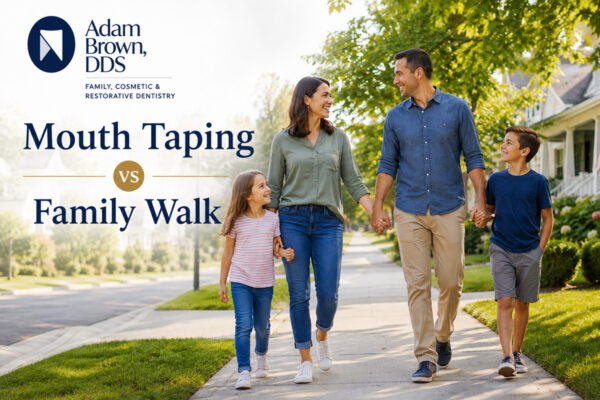
Take a family walk to relieve stress instead of mouth taping

Research suggests that light physical activity after a meal can help regulate the body’s internal clock, support healthy blood sugar levels, reduce stress, and improve sleep quality.

It’s not nearly as exciting as a viral TikTok trend.  But unlike many internet hacks, it has decades of scientific evidence behind it.

The Bottom Line

Mouth taping is one of the fastest-growing sleep trends on social media, and many people report positive experiences. However, it is not a one-size-fits-all solution, and for some individuals it may create unnecessary risks.

The bigger takeaway may be this:

If you wake up with dry mouth, suffer from chronic bad breath, experience frequent cavities, or struggle with poor sleep, your breathing habits could be playing a role.

A healthy night’s sleep doesn’t just affect your energy level. It can also affect the health of your teeth, gums, and smile.  If you have concerns about dry mouth, mouth breathing, or their impact on your dental health, talk with your dentist during your next visit.
Comments Off on Is Monroe, NC Stressed Out and Losing Sleep? Could Mouth Taping be the Answer

Mouthguards 101: When Do Kids (and Adults) Need Them?

2020-12-21T19:02:51+00:00December 21st, 2020|Mouthguards|

If your kid is active in any way, you probably know about the importance of wearing a helmet, knee pads, and goggles. But one protective device that doesn’t get quite as much attention as it should is the mouthguard. 

In some kids’ sports, mouthguards are required. However, many sports don’t require them, which makes it easy to underestimate their function or simply forget to have your child wear one. Nonetheless, if your kid is participating in a sport that involves any kind of potential contact—with other individuals, the ground, or objects—then wearing a mouthguard should be part of their daily routine. 

Still not convinced? Well, the American Dental Association (ADA) estimates that mouthguards help prevent more than 200,000 dental injuries each year. Moreover, about three-million teeth are knocked out in kids’ sports in any given year! And mouthguards not only help prevent teeth from being knocked out, chipped, or fractured, they can even protect your tongue, lips, and face from injury, as well as help to lessen the impact from blows to the head. 

Below, we’ll cover the basics of mouthguards—including the different types, the sports that necessitate them, how both kids and adults can benefit from them, and more. 


WHAT ARE MOUTHGUARDS? 

Also referred to as a sports guard or mouth protector, a mouthguard is a device worn over the teeth to protect them from blows to the head or face. Along with helping prevent injuries to your teeth, a mouthguard can help protect your face and jaw, as well as the soft tissues of your tongue, lips, and cheek lining. If your kid plays any kind of sport that involves body contact, falls, or moving equipment, they should be wearing a mouthguard at all times while participating. 

In most cases, a mouthguard covers only the upper teeth. This is because your upper teeth stick out more, which means they receive the brunt of impact during an incident. The bottom teeth are a little further back, so they are typically safer from harm. 

Mouthguards are not only useful for kids playing sports. Adults can also benefit from them, whether they play contact sports or suffer from sleep disorders (which we’ll cover later). 


DIFFERENT TYPES OF MOUTHGUARDS 

Not all mouthguards are created equally. There are three main types, each of which works well in specific instances:


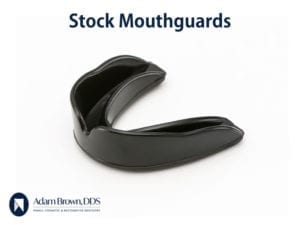
Stock Mouthguards 

This is the most accessible and cost-effective type of mouthguard, as almost any drugstore or sporting goods store carries them. Typically, stock mouthguards come in small, medium, and large sizes, and they simply fit over the upper teeth. 

Stock mouthguards work well if your kid plays contact sports only occasionally. However, whatever you open in the package is what you get. And since they’re not moldable, they usually don’t fit very well, are uncomfortable, and can make speaking difficult. 


Boil-and-Bite Mouthguards

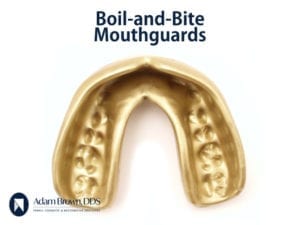
Going a step up, a boil-and-bite mouthguard is similar to a stock mouthguard, except you can mold it to your teeth. This makes a big difference. A boil-and-bite mouthguard comes in one size; you mold it by boiling it until it softens, placing it over your upper teeth, and biting down. The mouthguard then dries and hardens to the shape of your teeth. Considering that boil-and-bite mouthguards are just as widely available and almost as inexpensive, they are clearly the better option over stock mouthguards. 


Custom Mouthguards

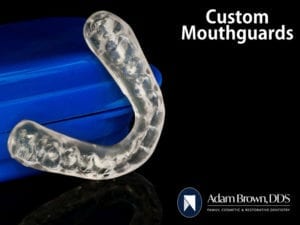
Then there are custom mouthguards. These are more expensive, but they are ideal when it comes to comfort and fit. In short, a dentist will take a mold of your teeth and fabricate a mouthguard to the exact specifications of your teeth and mouth structures. Kids who play sports regularly can greatly benefit from custom mouthguards, as can adults who deal with snoring or sleep apnea. 


SPORTS THAT CALL FOR MOUTHGUARDS 

As previously mentioned, your child will likely be required to wear mouthguards while playing certain sports. However, even if the league does not require it, that doesn’t mean your child should not wear a mouthguard. Here is a list of sports for which a mouthguard is necessary:

  • Hockey
  • Basketball
  • Indoor Soccer
  • Wrestling
  • Skiing
  • Snowboarding
  • Fencing
  • Football
  • Gymnastics
  • Outdoor Soccer
  • Lacrosse
  • Volleyball
  • Skateboarding
  • Raquetball
  • Martial Arts
  • Baseball
  • Softball

It’s worth noting that, along with competitions, mouthguards should be worn in all practices. 


BENEFITS OF CUSTOM MOUTHGUARDS 

The benefits of getting a custom mouthguard are many, which is why we’ve dedicated a section to explain why you should consider getting your child (or yourself) fitted for a custom mouthguard. Here are a few advantages of investing in a custom mouthguard from your dentist:


Perfect Fit 

Even at its best, a stock mouthguard will only fit well enough to stay on your teeth when your mouth is closed. A boil-and-bite mouthguard will fit better than that, but it will still be prone to coming loose, especially if you wear it regularly. That problem is fixed with a custom mouthguard. 

A qualified dentist like Adam Brown can have a mouthguard perfectly fitted to your teeth. You’ll simply come in to have an impression taken of your teeth, the cast will be sent to a dental lab, and you’ll come back to the dental office to test its fit. Chances are you’ll leave with a reliable mouthguard that fits snuggly and comfortably.


Optimal Comfort

When a custom mouthguard is fabricated for your teeth and mouth, it’s simply going to be more comfortable than a generic mouthguard. This is especially critical for children. After all, if your child’s mouthguard hurts or irritates them, they will be less likely to wear it of their own volition. 


Better Protection

Along with optimal fit and comfort, a custom mouthguard will provide you with more protection than other types. And protection is the whole point when it comes to mouthguards. The reason for this is that a custom impression will account for all the unique shapes and features of your teeth and mouth. For example, if your child has braces, a custom mouthguard will be shaped to accommodate the wires; that way, the wires won’t hurt your child or break during impact. 


The Right Thickness

One overlooked attribute of mouthguards is the thickness. How thick your mouthguard should be will depend on what you need it for. For example, if your child is participating in a sport that involves frequent significant impact, such as martial arts, they will need a thicker mouthguard than someone who plays racquetball. Your dentist will discuss with you the activities for which your mouthguard is needed and help you determine the appropriate thickness. 


Cost-Effectiveness

Yes, it will set you back more than a stock or boil-and-bite mouthguard, but a custom mouthguard can still prove to be cost-effective. In fact, it can end up being cheaper in the long run. This is for two reasons. First, generic mouthguards found at drugstores and sporting goods stores wear out rather quickly, meaning you have to replace them often. Second, because custom mouthguards are perfectly tailored to your specific teeth and mouth structures, chances of severe injuries and costly procedures are less likely. 


OTHER REASONS TO GET A MOUTHGUARD 

Mouthguards are essential for kids (and adults) who play sports. But they can also benefit the health and well-being of adults when it comes to snoring and sleep apnea. Let’s discuss how the right mouthguard can help with each of these conditions:


Snoring 

Almost everyone snores from time to time. But for some people, it’s a chronic problem that can lead to a wide range of health issues (in addition to being annoying to your partner). For example, snoring can disrupt sleep, which can lead to daytime sleepiness. This, in turn, can lead to difficulty concentrating, hindered productivity, frequent irritability or anger, and/or impaired driving. Snoring can also put you at a higher risk of high blood pressure, heart disease, stroke, and many other health issues. 

In the most basic sense, snoring occurs when the soft tissue in your upper airway vibrates. A custom mouthguard can fix this problem. The right mouthguard—one that fits over both the upper and lower teeth—will help to pull your lower jaw forward, which will keep your airway open throughout the night. There are numerous over-the-counter mouthguards that supposedly prevent or reduce snoring. But these types of mouthguards have yet to be proven to work as effectively as custom mouthguards. 


Sleep Apnea

Often associated with snoring but much more serious, sleep apnea is a condition that calls for immediate action. In essence, sleep apnea means that your breathing pauses repeatedly throughout the night. Each time you stop breathing, your body wakes up in order to start breathing again. Obviously, such frequent interruptions make it virtually impossible to get restful sleep. 

There’s more. Along with making you chronically sleepy, sleep apnea can lead to heart disease, diabetes, obesity, high blood pressure, and a whole host of other health conditions, including:

  • Depression
  • Memory loss
  • Acid reflux
  • A weakened immune system 
  • Asthma
  • Liver problems
  • Low blood oxygen 
  • High cholesterol

Much like with snoring, a custom mouthguard can benefit those with mild sleep apnea. By pulling your lower jaw and tongue forward, your airway is better able to remain open during sleep. You can even get a mouthguard that has a strap, which helps to re-adjust your lower jaw. It’s important to note, however, that if you suffer from a more severe case of sleep apnea, then you should ask your doctor about using a CPAP machine in lieu of a mouthguard. 


HOW TO CARE FOR MOUTHGUARDS 

If you or your child are using a mouthguard, it’s essential that you take the necessary steps to keep it clean and in good shape. Always brush and floss your teeth before wearing a mouthguard, and rinse the mouthguard with cool water before and after each use. To take it a step further, clean your mouthguard with a toothbrush and toothpaste between uses. Be sure to store your mouthguard in a hard, ventilated container so that it can stay dry while you’re not using it. Finally, always be on the lookout for signs of wear so that you will know when to replace it, and let your dentist evaluate it at each visit. 


WEARING MOUTHGUARDS WITH ORTHODONTIC DEVICES

Not only can you wear mouthguards when you have braces, dental implants, or dental bridges, but a custom mouthguard can go a long way in protecting both your teeth and orthodontic devices during impact. This is because the mouthguard fits around the unique shapes of your braces, implants, and/or bridges


INSURANCE AND MOUTHGUARDS 

Lastly, check with your dental insurance provider about their policies on custom mouthguards. Some plans will cover some or all of the costs associated with custom mouthguards, and you can also use funds from your health savings account (HSA) to pay for either custom or generic mouthguards. Moreover, some dental offices will provide you with a payment plan if your insurance will not cover the costs.  


In Sum 

The right mouthguard can do wonders in protecting your child from serious oral injuries when playing contact sports. The same goes for you if you suffer from snoring or sleep apnea as an adult. Be sure to consult your dentist about the type of mouthguard that will best meet the needs of you or your child. And remember, Adam Brown is just a call away if you would like an appointment to get fitted for that custom mouthguard! 

Comments Off on Mouthguards 101: When Do Kids (and Adults) Need Them?
Go to Top