
Let’s Talk About Fluoride in Monroe, NC
Who knew that a trace mineral we’ve had in our drinking water for more than 80 years could spark such controversy? But here we are in 2026, debating everything from politics and healthcare to, of all things, fluoride.

Here’s what you need to know if you live in or near Monroe, NC.
First, What Is Fluoride?
Fluoride is a naturally occurring mineral found in water, soil, and certain foods. Municipal water treatment facilities often add fluoride using a compound called fluorosilicic acid (H₂SiF₆), which releases fluoride ions when diluted in water.
Fluoride also occurs naturally in groundwater across North Carolina, although concentrations vary significantly by location. And that seemingly harmless fact is part of the controversy.
The amount of fluoride added to municipal drinking water is very small. In fact, study after study demonstrates that fluoride provides significant benefits in preventing tooth decay, particularly in children.
But … what if you have well water, and your well happens to sit above a mineral deposit where naturally occurring fluoride concentrations exceed recommended levels? Or perhaps you’re receiving additional fluoride from other sources, including toothpaste, certain foods, or alternative drinking water sources?
In these instances, prolonged exposure to excessive fluoride may result in the following adverse health consequences.
Dental Fluorosis: Changes in tooth enamel that develop when children consume excessive fluoride while permanent teeth are forming, generally before age eight. Most cases involve faint white markings. Severe cases can cause staining and pitting.
Skeletal Fluorosis: A rare bone condition associated with prolonged exposure to unusually high fluoride concentrations. Advanced cases can cause joint stiffness, pain, and changes in bone structure.
Neurodevelopmental and Endocrine Concerns: Research has associated higher fluoride exposure with lower IQ scores in children, particularly at concentrations above 1.5 ppm. Whether the recommended 0.7 ppm concentration presents similar risks remains uncertain. Thyroid effects have also been investigated, although findings are inconsistent.
Sounds Scary, Right? But how often do patients actually present with these conditions, with fluoride identified as a significant cause? And would they develop these conditions with or without added fluoride in their drinking water?
Dental Fluorosis: Approximately 23% to 41% of American adolescents have some degree of dental fluorosis, depending on the survey period. However, the vast majority of these cases are categorized as very mild or mild, presenting as faint white spots that are barely noticeable and do not require dental treatment. Severe cases involving pitting and brown staining are rare (~1% – 3.6%).
Skeletal Fluorosis (Extremely Rare): Clinical cases of skeletal fluorosis are practically nonexistent in the United States.
Neurodevelopmental and Endocrine Issues (Hard to Self-Identify): Patients do not typically walk into a clinic with a diagnosis of fluoride-induced lower IQ or fluoride-related hypothyroidism. Because these conditions have many potential causes, researchers investigate possible associations through large-scale epidemiological studies and public-health reviews rather than individual patient diagnoses.
The “with or without” question is at the heart of the scientific and political controversy.
Research indicates that dental fluorosis normally occurs in children living in non-fluoridated areas. Children naturally ingest fluoride from sources such as toothpaste, food and beverages, and groundwater containing naturally occurring minerals. However, the prevalence of dental fluorosis is generally higher in communities with fluoridated municipal drinking water.
Skeletal Fluorosis: The risk remains negligible at recommended municipal drinking water concentrations.
Neurodevelopmental and Endocrine Risks: Scientists continue investigating whether the recommended 0.7 ppm concentration in public drinking water contributes to cognitive or endocrine changes compared with unfluoridated populations.
So … What Happens When We Remove Fluoride?
Okay, so nobody wants their teenager to have stained or pitted teeth if it could be prevented, right? But herein lies the issue: When fluoride is removed from drinking water, tooth decay can increase.
For example, Calgary, Canada, voted to remove fluoride from its water in 2011, while nearby Edmonton continued fluoridation.
Within several years, researchers found that approximately 65% of second-grade children in unfluoridated Calgary had experienced cavities in their baby teeth, compared with 55% in fluoridated Edmonton.
Researchers also documented a greater increase in certain types of tooth decay among children growing up without fluoridated tap water.
Let’s Put This Into Numbers to Gain A Better Perspective
Hypothetically, if we removed all fluoride from North Carolina’s municipal water systems for the next ten years, how many of North Carolina’s 2.4 million children would experience additional cavities?
Conversely, if we added fluoride to all drinking water, how many children would experience severe dental fluorosis?
- The Cavity Increase
If North Carolina removed all fluoride from its water systems, it is projected that children across the state would experience roughly 1.67 million additional cavities over the next 10 years.
The Math: This scales the national JAMA Health Forum tracking model, which projects 25.4 million additional pediatric cavities over 5 years nationwide, down to North Carolina’s specific child population and extends it to a decade.
The Reality: This doesn’t mean 1.67 million individual children would develop cavities. Rather, it means the total number of cavity diagnoses would increase by that amount, with many vulnerable children developing multiple cavities.
- Severe Dental Fluorosis Cases
Conversely, completely removing fluoride from the water supply would prevent roughly 12,000 cases of severe dental fluorosis over that same 10-year period.
The Math: Severe fluorosis (visible pitting and brown staining) occurs when children under the age of 8 swallow too much fluoride while their permanent teeth are forming beneath the gums. It historically affects about 1% of children in optimally fluoridated environments. Over 10 years, roughly 1.2 million children will pass through that critical 0-to-8 age window in North Carolina.
The Reality: By removing added fluoride from municipal drinking water, the incidence of severe dental fluorosis could decline, potentially sparing thousands of children from severe enamel staining and the subsequent cosmetic dental costs required to correct it.
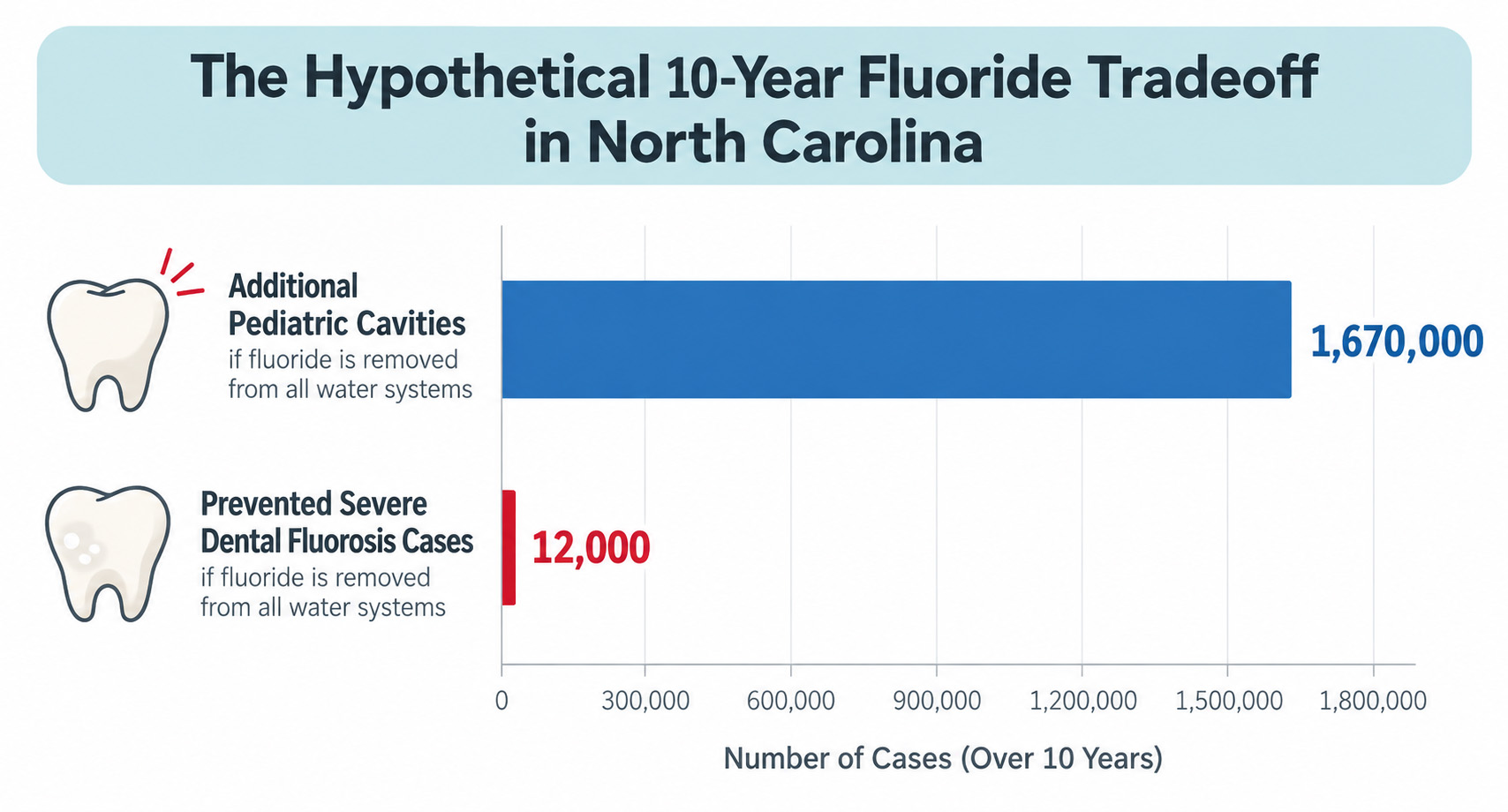
So, dear readers, this numerical tradeoff perfectly encapsulates the policy dilemma: Public health officials view 12,000 prevented cases of a cosmetic enamel condition as an unacceptable tradeoff if it requires allowing 1.67 million additional painful, costly cavities to develop among the state’s children. Critics, however, argue that no child should have their teeth structurally or cosmetically altered by a mandatory public water additive.
So, What’s in Your Water? – Well, that depends on where you live. Here’s the breakdown for Monroe, NC, and the surrounding area.
City of Monroe: YES, Fluoride Is Added.
The City of Monroe operates its own municipal water treatment system, including the John Glenn Water Treatment Plant. Published city water-quality reports document fluoride addition, with a reported concentration of approximately 0.60 ppm.
Union County (Surrounding Monroe): It’s Split.
In February 2024, Union County commissioners voted to prohibit adding fluoride at water treatment facilities controlled by the county.
However, that decision did not eliminate fluoridation throughout the county.
Yadkin River Water Treatment Plant: NO Added Fluoride.
The county discontinued fluoridation at this plant on March 4, 2024. It serves approximately one-third of Union County Water customers, including portions of eastern Union County.
Catawba River Water Treatment Plant: YES, Fluoride Is Added.
This facility, jointly owned with Lancaster County, South Carolina, continues fluoridation. It supplies approximately two-thirds of Union County Water customers, including many western Union County communities.
Some neighborhoods may receive water from either plant depending on seasonal demand and operational conditions. Consequently, your mailing address alone may not tell you whether your water contains added fluoride.
Neighboring Counties: Lincoln County has also discontinued fluoridation in its county-operated water system, while Stanly County has considered whether to continue the practice.
What Does This Mean for Your Family?
The answer to that question is very personal. Recognizing that opinions and parental preferences vary, the very best we at Dr. Adam Brown, DDS, can do is educate our patients about the risks and benefits of fluoride and help families make informed decisions. We invite you to ask Dr. Brown any questions you may have about fluoride, particularly when it comes to your children’s dental health.
Our goal is simple: healthy teeth and healthy smiles for the entire family.