
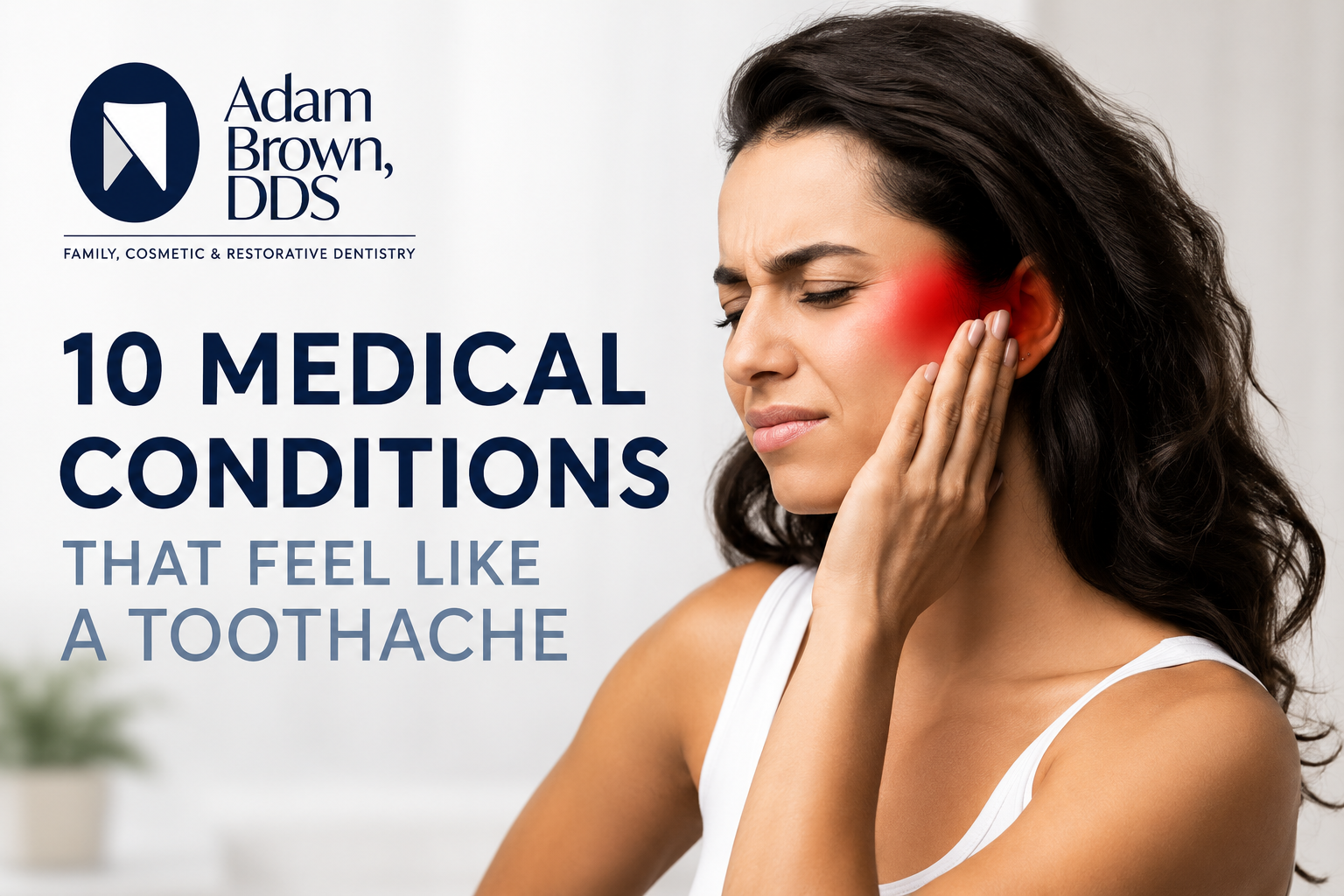
10 Medical Conditions That Feel Like a Toothache

2026-07-12T18:40:22+00:00July 12th, 2026|Adam Brown DDS, Cracked Teeth, Dental Crowns, Oral Health, Tooth Sensitivity|

Could Your Toothache Be Something Else? When Dental Pain Isn’t Actually a Tooth Problem
At Adam Brown DDS, every concern is worth taking seriously. Whether your pain turns out to be a cavity, a cracked tooth, an infection, or something entirely unrelated to dentistry, Dr. Brown and his team will perform a thorough examination and help you determine the next step.

A recent New York Times article titled The Electric Toothache told the remarkable story of a 69-year-old woman whose severe facial pain turned out to have nothing to do with her teeth.

Her symptoms came on suddenly. She described the pain as powerful electric shocks shooting through her jaw. The attacks were so intense that they stopped her in her tracks and made it difficult to go about her daily life.

Like most people would, she assumed she had a bad tooth and scheduled an appointment with her dentist.

Her dentist performed a thorough examination. X-rays were taken. Her gums were checked. Teeth were tapped to look for sensitivity. Existing fillings were examined, and the dentist searched for tiny fractures that can sometimes irritate a tooth’s nerve.

Everything looked normal.

Because hairline cracks can occasionally be too small to detect, her dentist recommended placing a crown to stabilize the tooth. If an invisible crack was causing the pain, the crown should have solved the problem.

Then the pain came back immediately returned.

Over the following months, she visited more dentists and even explored the possibility of a root canal. Fortunately, the endodontist (root canal specialist) couldn’t find evidence that the tooth’s nerve was diseased and declined to perform the procedure.

Over the next year, her life changed dramatically. She avoided chewing by changing her nutrition to smoothies only, tried not to open her jaw too wide, and even stayed out of cold weather because it triggered the painful attacks.

Finally, a friend mentioned a condition called trigeminal neuralgia.

She saw a neurologist, underwent an MRI, and received the correct diagnosis. A blood vessel was pressing against the trigeminal nerve, causing the intense “electric shock” pain. Her surgeon corrected the issue with the maxillary artery to relieve the pressure, and she was instantly pain-free.

What This Means for Dental Patients in Monroe, NC

This story highlights an important point: not every toothache is actually caused by a tooth.

Dentists are often the first healthcare professionals that people see when they experience pain involving the teeth, jaw, mouth, ear, or even around the eye. In many cases, the problem is dental. Sometimes, however, the source of the pain is something entirely different.

One of the most valuable qualities in any healthcare provider is knowing when something doesn’t fit the usual pattern.

An experienced dentist doesn’t simply look for cavities or broken teeth. They evaluate the entire situation, rule out common dental problems, and recognize when additional testing or a referral to another specialist may be the best next step.

In the New York Times case, the patient’s endodontist deserves credit for recognizing that the symptoms didn’t point to a root canal problem. Instead of performing an unnecessary procedure, the specialist acknowledged that another cause was likely involved. That decision ultimately led the patient to the correct diagnosis.

At Adam Brown DDS, our goal is to identify the true source of your discomfort whenever possible. If your examination suggests that your pain may not be coming from your teeth, we’ll discuss the findings with you and, when appropriate, recommend evaluation by the medical specialist best equipped to help.

Sometimes the most important answer a healthcare provider can give is, “I don’t think your tooth is causing this.”

That answer can save patients from unnecessary dental treatment and help them get to the real cause of their pain much sooner.

Medical Conditions That Can Mimic a Toothache

Trigeminal neuralgia – A chronic nerve disorder that causes sudden, severe, electric shock-like pain in the face. The pain is often mistaken for a toothache because it commonly affects the jaw and upper or lower teeth.

Sinus infection (sinusitis) – Inflammation or infection of the sinuses can create pressure on the roots of the upper back teeth, making healthy teeth feel painful or sensitive.

Temporomandibular joint (TMJ) disorder – Problems involving the jaw joint or surrounding muscles can cause pain that feels like it originates in one or more teeth, especially during chewing or jaw movement.

Ear infection – Because the nerves serving the ears and jaw are closely connected, an ear infection can produce pain that seems to come from the teeth or jaw.

Migraine headache – Some migraines cause facial pain, jaw pain, or tooth sensitivity rather than the classic headache, leading patients to believe they have a dental problem.

Cluster headache – These extremely painful headaches typically affect one side of the face and can produce intense pain around the eye, upper jaw, or teeth.

Shingles (herpes zoster) – Before the characteristic rash appears, shingles can cause burning or stabbing pain in the face or mouth that closely resembles severe dental pain.

Heart disease or angina – In some people, especially women, reduced blood flow to the heart can cause referred pain in the lower jaw or teeth instead of the chest. Sudden jaw pain accompanied by chest discomfort, shortness of breath, nausea, or sweating should be treated as a medical emergency.

Salivary gland infection or blockage – Infection or a blocked salivary duct can cause swelling and pain in the jaw or mouth that may be mistaken for a tooth infection.

Maxillary sinus or oral tumors – Although uncommon, certain benign or malignant growths involving the jaw, mouth, or sinus cavity can initially present as persistent tooth pain or unexplained facial discomfort that does not respond to routine dental treatment.

If you’re experiencing tooth pain, jaw pain, facial pain, or discomfort in your mouth, don’t ignore it—even if it seems minor or comes and goes. Dental problems are often easiest to treat when they’re caught early, and if your pain isn’t coming from a tooth, finding the real cause sooner can save you weeks or even months of frustration.

At Adam Brown DDS, every concern is worth taking seriously. Whether your pain turns out to be a cavity, a cracked tooth, an infection, or something entirely unrelated to dentistry, Dr. Brown and his team will perform a thorough examination and help you determine the next step. If the problem isn’t dental, we’ll help point you toward the medical specialist who can.

Sometimes the best treatment starts with simply asking the right questions. If something doesn’t feel right, schedule an appointment with Adam Brown DDS. We’d much rather evaluate a concern that turns out to be minor than have you continue living with pain that deserves answers.

Many thanks and appreciation to Lisa Sanders, MD. This article was inspired by her reporting published in The New York Times on July 3, 2026.
 

Comments Off on 10 Medical Conditions That Feel Like a Toothache

Cracked Teeth: What Should You Do?

2021-09-16T19:14:28+00:00September 15th, 2021|Cracked Teeth, Oral Health|

Cracked Teeth Help Charlotte NC

If you think you might have a cracked tooth, you’re not alone. In fact, it’s the most common culprit for tooth loss in developed countries. You can get a cracked tooth from grinding your teeth during sleep. You can get one from chewing hard foods like candy, ice, or nuts. You can also get one from:

  • A physically traumatic incident (e.g., a sports injury, a car accident, a fall, etc.).
  • Eating an extremely hot food and following it with an ice-cold beverage.  
  • Getting oversized fillings that weaken the tooth’s integrity. 
  • As a part of the natural aging process.

Here’s the point: Cracked teeth are common because there are many possible causes. And too many people wait too long to see a dentist after getting a cracked tooth, which can lead to a host of other problems. 

Don’t do that! Below, Adam Brown DDS has provided some essential information and advice about what to do when you get a cracked tooth (spoiler alert: it involves going to the dentist!). 


The Skinny on Cracked Teeth 

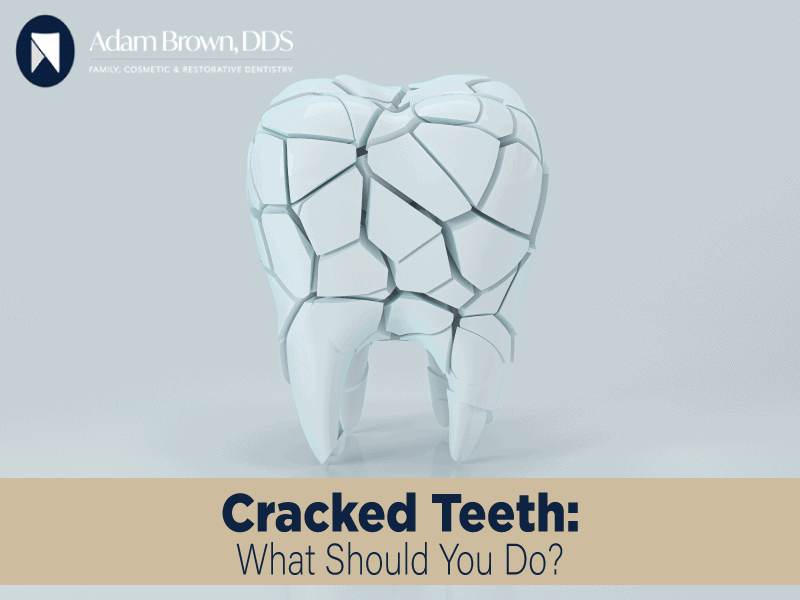
Cracked teeth can come in many forms. You can have a crack that extends to the gum line, a vertical root fracture, a fractured cusp, or craze lines, among others. Generally, a tooth’s crack starts at the chewing surface and eventually spreads down to the root. In some cases, the patient feels no discomfort, in which case it is still critical to seek dental care so that you can stop the damage in its tracks. 

The nature of the dental care you need will primarily depend on how far the crack has extended into the tooth. For example, if the crack hasn’t spread to the pulp, you can probably treat it with a crown. But if the crack has grown to the center of the tooth, you will likely need both a root canal and a crown. You’ll probably notice if the damage gets to that point because it usually results in significant pain.

A cracked tooth can get even more intense than that. If the crack extends through the center of the tooth and down below the gum line, the only option may be to extract the tooth. Sometimes a tooth crack can begin at the root and work its way up, which is known as a vertical root fracture. This requires extensive dental care and often goes unnoticed until the patient feels swelling around the tooth or gum, or if the area becomes infected. 

A cusp fracture occurs when only a portion of your tooth breaks off. In most cases, a cusp fracture can be treated with a new filling or a crown. And then there are craze lines, which are essentially thin lines that show through the surface of the teeth. These cracks are shallow and require no treatment. They are simply a result of the aging process and are only superficial.

You may not be able to tell if you have a cracked tooth just by looking in the mirror. But there are some symptoms to keep in mind that can indicate that you have a cracked tooth. For instance, if you have pain that comes and goes and is exacerbated when chewing food, or you experience discomfort when consuming hot or cold foods or beverages, you might have a cracked tooth. And if your tooth is extra sensitive when eating sticky, sweet, or sour foods, that too can be a sign. Furthermore, cracked teeth often reveal themselves when the edges of the teeth become sharp.


Why You Should Go to the Dentist 

Even if you notice symptoms of a cracked tooth, there’s really no way for you to know the extent of the damage. So, no matter the size of the crack or chip in your tooth, your first action should be to call your dentist to set up an appointment. Fortunately, there are some steps you can take to slow the progress of the crack until you can get to the dentist, which we will discuss here later. 

Oftentimes, your mouth injury will not require you to get emergency treatment, which means that you should be OK until your dentist is able to see you during normal work hours. So, call yourself fortunate if you have a crack or a chip in your tooth that isn’t causing you to hunch over in pain! That said, remember that calling the dentist should be a top priority no matter the intensity of the damage. Let’s discuss why in more detail:

Preventing Decay and Infection

Failure to treat your cracked tooth promptly can result in decay and/or infection. The rough edges of a cracked tooth tend to collect more food and bacteria than normal while also leaving the area harder to clean. And if the crack or chip in your tooth is sizable, it can expose the dentin underneath your enamel, which increases the risk of decay even more. Thus, cavities and even infection can quickly ensue. 


Minimizing Bite Problems

Your mouth works through muscle memory, and your bite contacts must be precise for your chewing to be proper. Even the smallest chip can change how your teeth come together during a bite and, ultimately, how you chew. If left unaddressed, this can cause your teeth to wear unevenly and potentially lead to bruxism. 


Appearance

Some people are not bothered by a chip in their tooth, but it’s impossible to ignore. So, if you want a big, perfect smile, the chip in your tooth will keep that from happening because it interrupts the symmetry of your smile, or at the very least, it highlights the black space behind the cracked tooth.


Increased Sensitivity

Having a cracked tooth can get really uncomfortable, really fast. Essentially, a crack in your tooth will decrease the insulation between the sensitive nerve in the tooth and any food or drinks you consume. Oftentimes, you will begin feeling sensitivity around where your tooth is cracked, in which case it’s time to call the dentist. 


You Don’t Know How Bad It Is

Too many people notice a small crack or chip in their tooth and assume that it is the extent of the damage. While the crack or chip itself can spread and cause a whole host of problems, consider the force behind whatever caused your tooth damage in the first place. That force could have impacted the roots, which could lead to your tooth getting infected, falling out, or at the very least becoming discolored. Only a dental care professional can assess the full extent of the damage to your tooth. 


Stress Relief

Being aware of the plethora of potential risks that come with a cracked tooth, chances are you won’t be able to avoid worrying about how bad the injury is. Rather than torturing yourself and constantly trying to ignore your anxiety, get evaluated by your dentist to get a professional diagnosis.


Diagnosing Cracked Teeth 

One common way dentists examine for cracked teeth is to take an X-ray. But sometimes an X-ray won’t reveal a cracked tooth, not to mention every patient doesn’t exhibit the same symptoms. If you go to your dentist for a diagnosis, you can expect them to inquire about your dental history, conduct an in-depth visual examination, and feel for the crack with a dental explorer. 

In many cases, a dentist will apply dental dye to see if it highlights the tooth’s crack, as well as probe your gums to identify any inflammation present. Another practical step a dentist might take is to have you bite down on something, such as a band, which might make you feel pain once you release the bite. And of course, you may get an X-ray; even if it doesn’t show the crack in your tooth, it can reveal poor pulp health, which can be a sign of a crack. 


Until You Can Get to the Dentist  

So, you think you may have a cracked tooth and the pain has become excruciating. If your dentist doesn’t recommend emergency treatment, you may be able to minimize the progression of the damage and the pain by taking action at home. 


First Aid at Home 

Most of the time, if you feel pain from a cracked or broken tooth, it is because the tooth’s dentin layer has become exposed. If you’re not able to make it to the dentist (i.e., it’s in the middle of the night or your dentist doesn’t have any openings), bite down gently on a strip of gauze; this can help ease the pain and the bleeding if there is any. And be sure to look for any broken pieces of your tooth so that you can bring them to your dentist appointment. These pieces will not be able to be reattached, but your dentist can assess whether it was tooth enamel or an old filling.

There are also some things that you should not do in the event that you get a cracked tooth and must wait for dental care. You basically want to avoid anything that can exacerbate the damage or pain. Stay away from extremely hot or cold food or drinks. Try to avoid sugary or acidic foods and drinks. And don’t eat any hard candy, nuts, or other hard foods. Once your tooth is treated, you can get back to your normal routine. 


Mitigating the Pain

If your tooth pain becomes significant while you are waiting to see the dentist, ask your dental care provider if you can take a pain reliever like Tylenol or Advil. Don’t take aspirin, however, because it can disrupt blood clotting, which won’t be a good thing if you end up requiring a root canal. 

Oil of cloves is something else you can take. As a natural anesthetic, dentists have used oil of cloves for more than 100 years. Simply soak a cotton ball in the oil and hold it on the cracked tooth for about ten seconds, taking care not to swallow. Or, you could go with an over-the-counter dental anesthetic such as Anbesol or Orajel. 

It’s also a good idea to floss after each meal, as this will remove bacteria that could aggravate the damage done to the area around your cracked tooth. Just use the floss gently around the painful tooth. Also, keep your head more elevated than you normally would when you sleep, as it can relieve some of the pressure from the painful inflammation of the exposed nerve in your cracked tooth. Moreover, swish warm salt water in your mouth three times a day to further protect the infected area from bacteria. 


Conclusion

Just because cracked teeth are common doesn’t mean that they should be taken lightly. If you notice potential symptoms of a cracked tooth, you should contact your dentist’s office as soon as possible and follow the steps above for mitigating the problem until you can see the dentist. And of course, keep up with your oral hygiene routine, and make an effort to prevent cracked teeth in the future!

Patients with cracked teeth come into our office all the time, and we would love to examine you and figure out the best way to fix the problem. Contact Adam Brown DDS today with any questions or concerns you may have! (704) 289-9519


Comments Off on Cracked Teeth: What Should You Do?
Go to Top