
Let’s Talk About Fluoride in Monroe, NC

2026-10-31T13:25:15+00:00October 31st, 2026|Adam Brown DDS, Fluoride, Kids Teeth, Oral Health|

Who knew that a trace mineral we’ve had in our drinking water for more than 80 years could spark such controversy? But here we are in 2026, debating everything from politics and healthcare to, of all things, fluoride.

Fluoride Risks in Water in Monroe, NC

Here’s what you need to know if you live in or near Monroe, NC.

First, What Is Fluoride?

Fluoride is a naturally occurring mineral found in water, soil, and certain foods. Municipal water treatment facilities often add fluoride using a compound called fluorosilicic acid (H₂SiF₆), which releases fluoride ions when diluted in water.

Fluoride also occurs naturally in groundwater across North Carolina, although concentrations vary significantly by location. And that seemingly harmless fact is part of the controversy.

The amount of fluoride added to municipal drinking water is very small. In fact, study after study demonstrates that fluoride provides significant benefits in preventing tooth decay, particularly in children.

But … what if you have well water, and your well happens to sit above a mineral deposit where naturally occurring fluoride concentrations exceed recommended levels? Or perhaps you’re receiving additional fluoride from other sources, including toothpaste, certain foods, or alternative drinking water sources?

In these instances, prolonged exposure to excessive fluoride may result in the following adverse health consequences.

Dental Fluorosis: Changes in tooth enamel that develop when children consume excessive fluoride while permanent teeth are forming, generally before age eight. Most cases involve faint white markings. Severe cases can cause staining and pitting.

Skeletal Fluorosis: A rare bone condition associated with prolonged exposure to unusually high fluoride concentrations. Advanced cases can cause joint stiffness, pain, and changes in bone structure.

Neurodevelopmental and Endocrine Concerns: Research has associated higher fluoride exposure with lower IQ scores in children, particularly at concentrations above 1.5 ppm. Whether the recommended 0.7 ppm concentration presents similar risks remains uncertain. Thyroid effects have also been investigated, although findings are inconsistent.

Sounds Scary, Right?  But how often do patients actually present with these conditions, with fluoride identified as a significant cause? And would they develop these conditions with or without added fluoride in their drinking water?

Dental Fluorosis: Approximately 23% to 41% of American adolescents have some degree of dental fluorosis, depending on the survey period. However, the vast majority of these cases are categorized as very mild or mild, presenting as faint white spots that are barely noticeable and do not require dental treatment. Severe cases involving pitting and brown staining are rare (~1% – 3.6%).

Skeletal Fluorosis (Extremely Rare): Clinical cases of skeletal fluorosis are practically nonexistent in the United States.

Neurodevelopmental and Endocrine Issues (Hard to Self-Identify): Patients do not typically walk into a clinic with a diagnosis of fluoride-induced lower IQ or fluoride-related hypothyroidism. Because these conditions have many potential causes, researchers investigate possible associations through large-scale epidemiological studies and public-health reviews rather than individual patient diagnoses.

The “with or without” question is at the heart of the scientific and political controversy.

Research indicates that dental fluorosis normally occurs in children living in non-fluoridated areas. Children naturally ingest fluoride from sources such as toothpaste, food and beverages, and groundwater containing naturally occurring minerals.  However, the prevalence of dental fluorosis is generally higher in communities with fluoridated municipal drinking water.

Skeletal Fluorosis: The risk remains negligible at recommended municipal drinking water concentrations.

Neurodevelopmental and Endocrine Risks: Scientists continue investigating whether the recommended 0.7 ppm concentration in public drinking water contributes to cognitive or endocrine changes compared with unfluoridated populations.

So … What Happens When We Remove Fluoride?

Okay, so nobody wants their teenager to have stained or pitted teeth if it could be prevented, right?  But herein lies the issue: When fluoride is removed from drinking water, tooth decay can increase.

For example, Calgary, Canada, voted to remove fluoride from its water in 2011, while nearby Edmonton continued fluoridation.

Within several years, researchers found that approximately 65% of second-grade children in unfluoridated Calgary had experienced cavities in their baby teeth, compared with 55% in fluoridated Edmonton.

Researchers also documented a greater increase in certain types of tooth decay among children growing up without fluoridated tap water.

Let’s Put This Into Numbers to Gain A Better Perspective

Hypothetically, if we removed all fluoride from North Carolina’s municipal water systems for the next ten years, how many of North Carolina’s 2.4 million children would experience additional cavities?

Conversely, if we added fluoride to all drinking water, how many children would experience severe dental fluorosis?

  • The Cavity Increase

If North Carolina removed all fluoride from its water systems, it is projected that children across the state would experience roughly 1.67 million additional cavities over the next 10 years.

The Math: This scales the national JAMA Health Forum tracking model, which projects 25.4 million additional pediatric cavities over 5 years nationwide, down to North Carolina’s specific child population and extends it to a decade.

The Reality: This doesn’t mean 1.67 million individual children would develop cavities. Rather, it means the total number of cavity diagnoses would increase by that amount, with many vulnerable children developing multiple cavities.

  • Severe Dental Fluorosis Cases

Conversely, completely removing fluoride from the water supply would prevent roughly 12,000 cases of severe dental fluorosis over that same 10-year period.

The Math: Severe fluorosis (visible pitting and brown staining) occurs when children under the age of 8 swallow too much fluoride while their permanent teeth are forming beneath the gums. It historically affects about 1% of children in optimally fluoridated environments. Over 10 years, roughly 1.2 million children will pass through that critical 0-to-8 age window in North Carolina.

The Reality: By removing added fluoride from municipal drinking water, the incidence of severe dental fluorosis could decline, potentially sparing thousands of children from severe enamel staining and the subsequent cosmetic dental costs required to correct it.
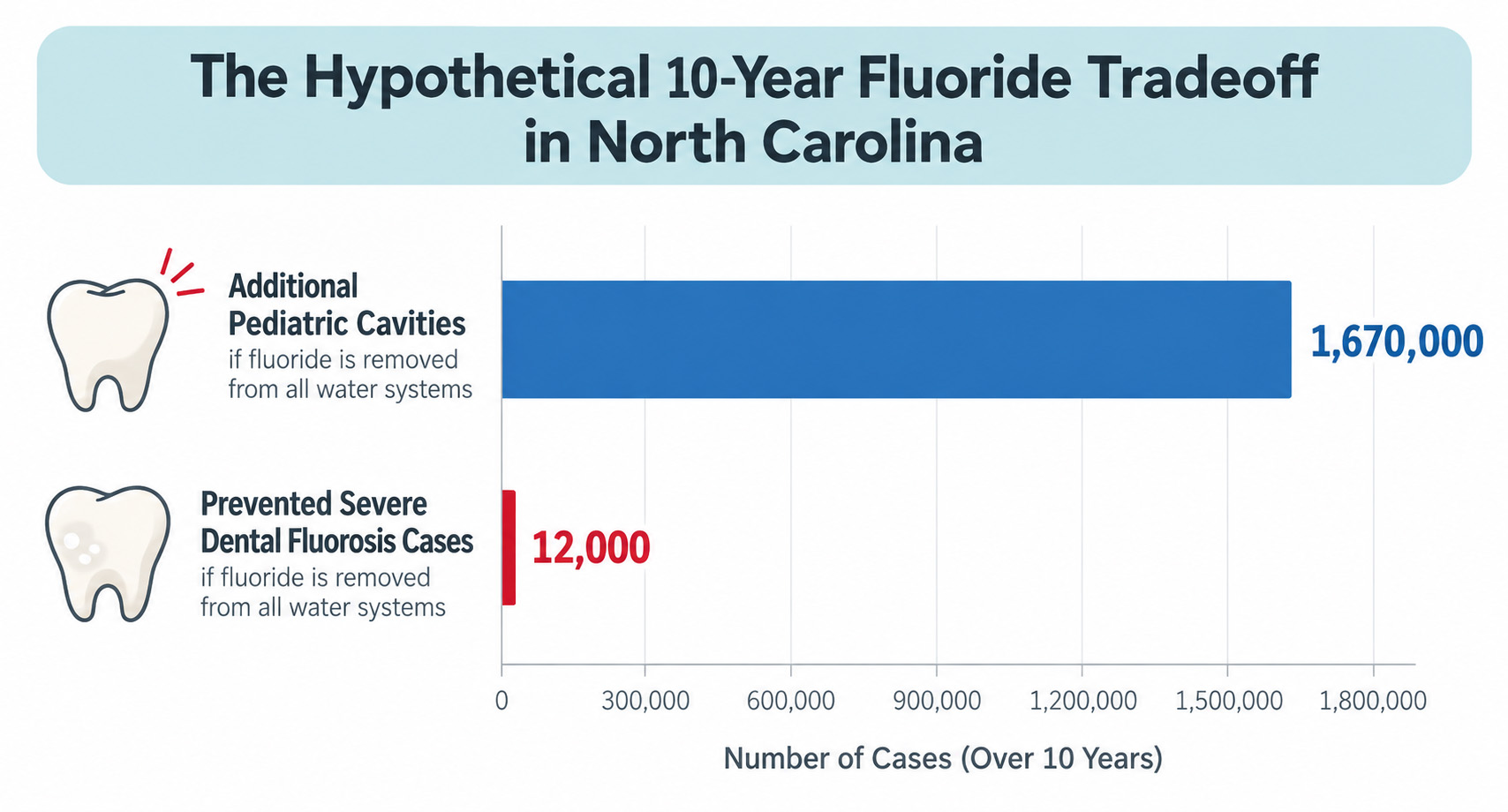
Hypothetical Fluoride Tradeoff in North Carolina

So, dear readers, this numerical tradeoff perfectly encapsulates the policy dilemma: Public health officials view 12,000 prevented cases of a cosmetic enamel condition as an unacceptable tradeoff if it requires allowing 1.67 million additional painful, costly cavities to develop among the state’s children. Critics, however, argue that no child should have their teeth structurally or cosmetically altered by a mandatory public water additive.

So, What’s in Your Water? –  Well, that depends on where you live. Here’s the breakdown for Monroe, NC, and the surrounding area.

City of Monroe: YES, Fluoride Is Added.

The City of Monroe operates its own municipal water treatment system, including the John Glenn Water Treatment Plant. Published city water-quality reports document fluoride addition, with a reported concentration of approximately 0.60 ppm.

Union County (Surrounding Monroe): It’s Split.

In February 2024, Union County commissioners voted to prohibit adding fluoride at water treatment facilities controlled by the county.

However, that decision did not eliminate fluoridation throughout the county.

Yadkin River Water Treatment Plant: NO Added Fluoride.

The county discontinued fluoridation at this plant on March 4, 2024. It serves approximately one-third of Union County Water customers, including portions of eastern Union County.

Catawba River Water Treatment Plant: YES, Fluoride Is Added.

This facility, jointly owned with Lancaster County, South Carolina, continues fluoridation. It supplies approximately two-thirds of Union County Water customers, including many western Union County communities.

Some neighborhoods may receive water from either plant depending on seasonal demand and operational conditions. Consequently, your mailing address alone may not tell you whether your water contains added fluoride.

Neighboring Counties: Lincoln County has also discontinued fluoridation in its county-operated water system, while Stanly County has considered whether to continue the practice.

What Does This Mean for Your Family?

The answer to that question is very personal.  Recognizing that opinions and parental preferences vary, the very best we at Dr. Adam Brown, DDS, can do is educate our patients about the risks and benefits of fluoride and help families make informed decisions.  We invite you to ask Dr. Brown any questions you may have about fluoride, particularly when it comes to your children’s dental health.

Our goal is simple: healthy teeth and healthy smiles for the entire family.


Comments Off on Let’s Talk About Fluoride in Monroe, NC

Why Some Monroe, NC Residents Are Rediscovering Gold Crowns

2026-06-22T21:23:35+00:00May 12th, 2026|Dental Crowns|

Why younger adults in Monroe, NC  are rediscovering Gold Crowns

When many people think of gold crowns, they picture a parent or grandparent smiling with a flash of gold in the back of their mouth.

For decades, gold restorations were considered one of the most durable and dependable treatments available in dentistry. While porcelain and ceramic crowns have become increasingly popular because they closely resemble natural teeth, gold crowns continue to offer advantages that many patients find appealing—especially for back teeth where strength and longevity matter most.

Younger adults are discovering few dental materials have matched the long-term performance of gold.Monroe, NC is a young and growing community, but many younger adults are discovering what previous generations already knew: when it comes to durability, few dental materials have matched the long-term performance of gold.

Why Do Dentists Like Gold Crowns?

Many dentists consider gold one of the finest restorative materials ever developed.

Gold crowns are exceptionally durable, highly biocompatible, and remarkably resistant to fracture. While modern tooth-colored materials continue to improve, gold has earned a reputation over decades of successful use.

Unlike porcelain, which can chip under extreme pressure, gold alloys have a slight flexibility that allows them to absorb chewing forces while maintaining their integrity.

For molars and other teeth that experience heavy chewing pressure, gold remains one of the most respected restorative materials in dentistry.

How Long Does a Gold Crown Last?

One of the most compelling reasons patients choose gold is longevity.

While every patient is different, gold crowns commonly remain functional for 20 to 40 years and sometimes much longer. Many dentists continue to see patients whose gold restorations were placed decades ago and are still performing well.

For some Monroe, NC families, the best endorsement of a gold crown isn’t an advertisement—it’s seeing a parent or grandparent who has worn the same crown for 30 years or more.

Does Gold Fit Better Because It Is Softer?

Surprisingly, yes.

Dental gold crowns are not made from pure gold. Instead, they are fabricated from specialized alloys that combine strength and durability.

Even so, gold remains more malleable than porcelain. This allows dental laboratories to create restorations with extremely precise margins and excellent adaptation to the prepared tooth.

Many dentists appreciate gold because it creates a tight fit and excellent seal around the tooth structure, helping reduce the spaces where bacteria can collect.

Why Is Gold Gentle on Natural Teeth?

One concern with any restoration is how it affects the opposing tooth.

Some ceramic materials are harder than natural enamel and may contribute to wear on the teeth they contact during chewing.

Gold behaves differently.

Its wear characteristics are remarkably similar to natural tooth enamel. Rather than acting like sandpaper against opposing teeth, gold tends to wear in harmony with the natural bite.

This is one reason many dentists continue to view gold as a conservative and tooth-friendly option.

Does a Gold Crown Require Less Removal of Healthy Tooth Structure?

In many cases, yes.

Because gold alloys are incredibly strong, they can often be fabricated thinner than porcelain crowns while still maintaining their structural integrity.

That means less healthy tooth structure may need to be removed during preparation.

For patients who value preserving as much natural tooth as possible, this can be a significant advantage.

Are Gold Crowns Making a Comeback?

Gold crowns never completely disappeared.

While many patients prefer tooth-colored restorations, others are becoming increasingly interested in longevity, durability, and long-term value.

A growing number of patients are asking practical questions:

  • How long will this crown last?
  • Will it chip?
  • Will it wear down other teeth?
  • How many times might it need replacement?

When viewed through that lens, gold crowns continue to make a compelling case.

Sometimes the newest solution isn’t necessarily the longest-lasting one.

Why Are Gold Crowns More Expensive?

How much do gold crowns cost?The answer is partly tied to the price of gold itself.

Gold has long been viewed as a store of value during periods of inflation and economic uncertainty. Over the past several decades, the market price of gold has increased significantly.

Because dental gold alloys contain precious metals, rising gold prices can increase laboratory costs associated with fabricating a gold crown.

However, the metal itself is only one component of the total cost.

The fee for a crown also reflects:

  • Examination and diagnosis
  • Tooth preparation
  • Digital scans or impressions
  • Laboratory fabrication
  • Placement and adjustments
  • Follow-up care

For that reason, the difference between a gold crown and a porcelain crown is often smaller than many patients expect.

Gold Crown vs. Porcelain Crown: Which Offers Better Value?

Many people focus exclusively on the initial cost.

A better question may be:

“What is the cost over the life of the restoration?”

A porcelain crown may cost less initially, but it may eventually need replacement because of chipping, cracking, or wear.

A gold crown may require a larger upfront investment, but its exceptional longevity can make it surprisingly cost-effective over time.

Many patients view gold crowns the same way they view a quality roof, a dependable truck, or a well-built appliance: the initial investment may be higher, but the long-term value can be substantial.

Is a Gold Crown Right for You?

Gold crowns are not the ideal choice for every patient.

Many people prefer porcelain or ceramic restorations because they blend seamlessly with natural teeth.

Gold Crown vs Porcelain

However, for back teeth that experience significant chewing forces, gold remains one of the most durable and proven restorative materials available.

The best choice depends on your oral health, cosmetic preferences, bite forces, and long-term goals.  Sometimes the best innovations are brand new.  And sometimes the best solutions are the ones that have already proven themselves over generations.

Speak with Dr. Adam Brown in Monroe, NC about Gold Crowns for your dental repairs.  704.289.9519


Comments Off on Why Some Monroe, NC Residents Are Rediscovering Gold Crowns

New Look, Same Great Family   

2020-09-09T14:55:17+00:00August 21st, 2020|General|

Dr. Brown and his team of dentists, hygienists, and dental assistants have been providing quality dental services in Monroe for over 37 years. Adam Brown, DDS (Formerly Carolina’s Dental Choice), now owned and operated by Doctor Adam Brown, will to continue with excellent services and innovative practice. Our patients have found that professional dental procedures, no matter how intricate, can be stress-free thanks to our team of professionals.

Dr. Adam Brown grew up in Raleigh, North Carolina, and continues to make the Carolinas his home, currently living in Charlotte.  

After getting a bachelor’s degree in construction management from East Carolina University, Dr. Brown established a career in residential home building and real estate industries. But after a 13-year career, Dr. Brown felt the call to dentistry. It wasn’t a far stretch for him to go from managing a successful career in the building industry to becoming a dentist, since his father—Dr. Don Brown who founded Carolina’s Dental Choice (now Adam Brown, DDS)—has been a celebrated dentist for many years.

Dr. Brown made his decision and headed to the University of North Carolina at Chapel Hill School of Dentistry. And once his schooling was complete, and he obtained his doctoral degree, he joined the family practice.

In November of 2020, Dr. Adam Brown purchased Carolina’s Dental Choice from Dr. Don Brown. After taking over the practice, Dr. Brown has transformed Carolina’s Dental Choice into Adam Brown, DDS.

Dr. Brown is a member of the American Dental Association and the North Carolina Dental Society. He lives in Charlotte with his wife, two kids, and two labs. In his free time, you can find him spending time with friends and family, especially if it’s on the lake or at the golf course.


About Us

At Adam Brown, DDS we have expert technology (designed not to inflict pain, but rather to perfect your smile), great customer care, and an interesting, fun staff.

One great aspect of our office is that it’s unique. To begin with, notice the structure of our building. Doesn’t look like a dental practice, does it? That’s because our office is housed in a…well, a house. We even have a porch! Our physical structure matches the overall goal of our practice: we want you to feel as though you are family. Inside, our friendly office is completely new. Freshly painted walls and trim. Beautiful wood floors. Soft lighting and light music to set the mood. Doesn’t sound like your typical dental practice, does it? That’s because we aren’t.


What Sets Us Apart

How much we care! Not only does our family atmosphere immediately put you at ease, our variety of services offered, and the technology used, provide the highest quality of dental work you will find. When it comes to practices such as teeth whitening, preventative care, and restorative and cosmetic dentistry, we have the latest, newest technology to complete all services quickly, easily, and professionally. Here are just a few of the services we offer:


Another quality that makes us different is our ability to conduct high-level restorative dentistry. Restorative dentistry is an intricate procedure, often left for those few specialty dentists with steady hands and a vast knowledge of the practice. Luckily for us, Dr. Brown is one of these specialists. 

What is restorative dentistry, exactly? It is the concept of reproducing or repairing teeth and adjoining bones and tissue through the use of metal and ceramic materials in order to make them whole again. This is a process that can be completed by filling, onlay, crowns, or implants. Dr. Brown and his team are one of the best practices that offer full mouth veneers and crowns. Custom veneers can be a tricky process to grasp. But, between 1-2 visits, you can have the smile you deserve and gain back the confidence that was once lost.

Dr. Brown’s expertise in performing difficult, intricate dental procedures, and his wonderful rapport with patients, provides a perfectly rounded practice. And, in order to establish Adam Brown, DDS as the best practice in Monroe, Dr. Brown has hired a staff that shares in his desire for perfection on all fronts of customer care. From our office manager and patient service operator to our fellow dentists and assistants, all are trained and excited to offer you excellent dental service.


A Few Tips for Great Oral HealthAdam Brown DDS Staff

Before you come to visit us for your regular cleaning, or to have other dental procedures done, here are a few tips to help maintain your oral health:


  1. Get the Right Toothpaste

A lot of people like to rush right to the whitening toothpastes. It makes sense, who doesn’t want white teeth? But when you are juicing the acid that does come into contact with your teeth (and no matter what you do, there will be a least a tiny bit that does) makes them softer, more sensitive. And when you combine the harsh chemicals in whitening toothpaste, it can cause a lot of discomfort. It’s better to use toothpaste that is made for sensitive teeth. This will clean the teeth well without hurting them. And, honestly, brushing twice a day will do well at keeping your teeth white. If you feel you need something more there are plenty of products out there that do not hurt the teeth, even sensitive strips and mouthwashes that can advance your whitening.


  1. Avoid Over-Brushing

Never thought you could brush too much, did you? Well, you can. Too much brushing can actually help the acid erode the enamel off your teeth. As previously said, juicing can leave your teeth extra sensitive. To go and brush excessively after that can cause some problems. It is best to stick to the twice a day standard. And when you do brush, use a soft or medium bristle. Brush lightly, and use a mechanical toothbrush if possible. These are made to get to those hard-to-reach places and they put the perfect amount of pressure on your teeth and gums. And nowadays, you don’t have to spend an arm and a leg to get one. There are plenty of reasonably priced electric toothbrushes out there. You just have to do a bit of research.


  1. Use Mouthwash Regularly

Just like flossing and brushing, the twice a day rule is all you need with mouthwash. If you feel the need to rinse more than that use water. But once in the morning, then again at night, can do wonders to clean the mouth. Mouthwash also helps keep your teeth white and your breath fresh.


  1. Drink Through Straws Whenever Possible

When drinking your favorite blended healthy concoction, it is possible to keep most of the liquid from having too much contact with your teeth. And, this is true, especially with thicker drinks. By using a straw, you can keep even more liquid from hitting your teeth. That’s why it’s a good idea to have many different types of straws around. A wide straw for thick juices, and narrow or regular-sized for normal densities, and a bendy straw just because they’re fun. Do stay away from those trendy metal straws though, as they can chip your teeth. Basically, any way of transferring your juice directly from the cup to your throat without touching anything (besides the straw), the better. Just be careful, using a straw makes drinking a lot of liquid much easier. You don’t want to overdo it on the juicing!


  1. Visit Your Dentist Twice a Year

This is one of the most important things to do. One visit to the dentist every six months is the perfect way to gauge how well your teeth are handling the juicing. A dentist can tell you if your teeth are becoming too sensitive or stained and advise you on what to do. It’s also good because you get a professional cleaning where someone is meticulously searching your mouth for cavities, bits of food, or anything else.


Come Join Our Family!

Though we may have a new name, we are still the same family here to provide excellent dental services. Set up your next dental appointment, no matter what it is you need to be done, with Adam Brown, DDS today.

Comments Off on New Look, Same Great Family   
Go to Top